
Every visit, planned and protected
Officers build their itinerary, get turn-by-turn directions to each door, and stay covered by a visit timer that calls for help if they don't check in.
Current stop
 1
1James Morrison
215 Riverbend Ct, Covington
Up next
 2
2DeAndre Williams
1840 Cypress Bend Dr, Covington
 3
3Sarah Chen
94 Lakeshore Blvd, Mandeville
 4
4Marcus Johnson
320 Pinewood Trace, Covington
 5
5Carlos Martinez
77 Bayou Liberty Rd, Slidell
 6
6Maria Gonzalez
12 Heritage Oaks Dr, Madisonville
What is Shadowtrack officer safety?
Shadowtrack's officer safety suite supports community corrections officers in the field. It plans the day in seconds, attaches hazard warnings to addresses, navigates door to door, runs visit timers that automatically call for help, and includes a silent duress PIN, so every field visit is planned and protected.
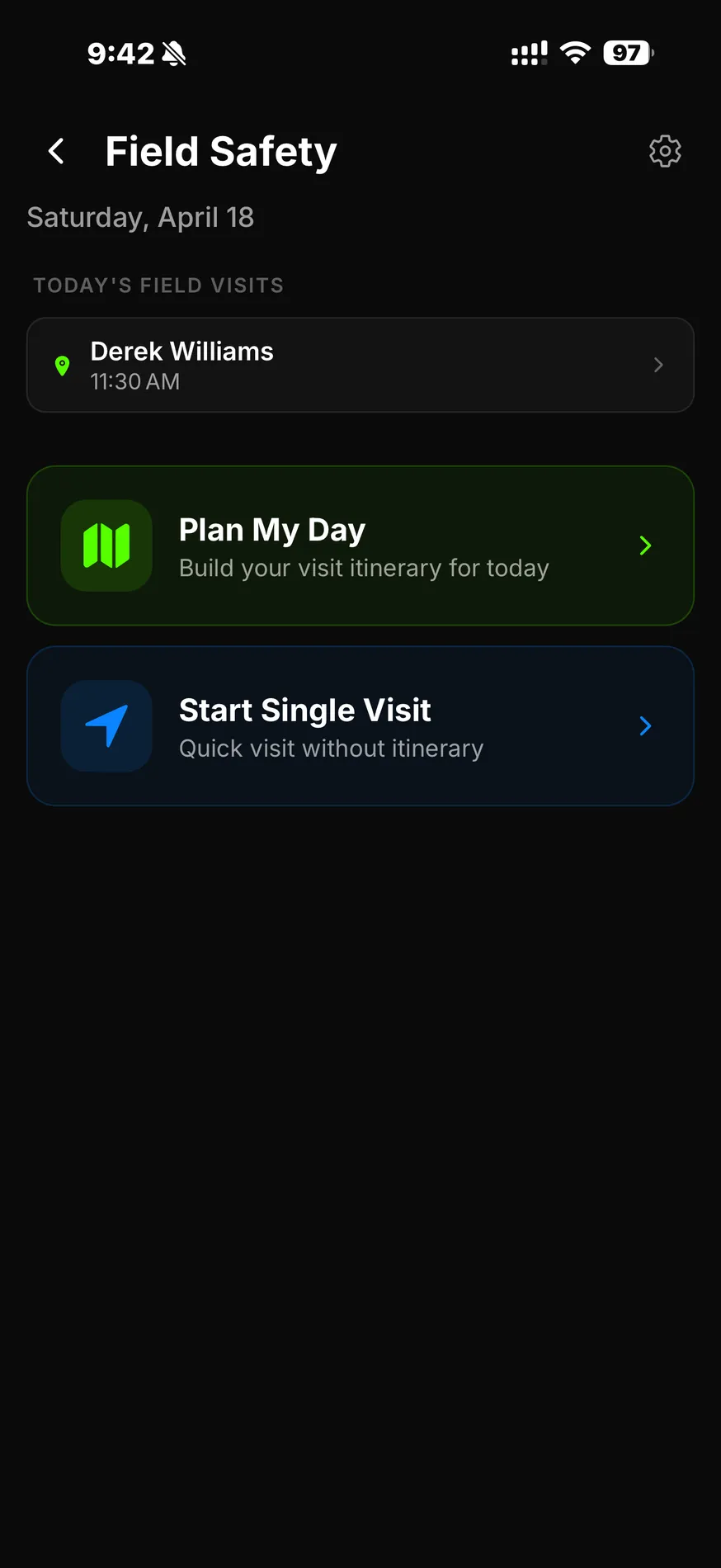
The day starts here
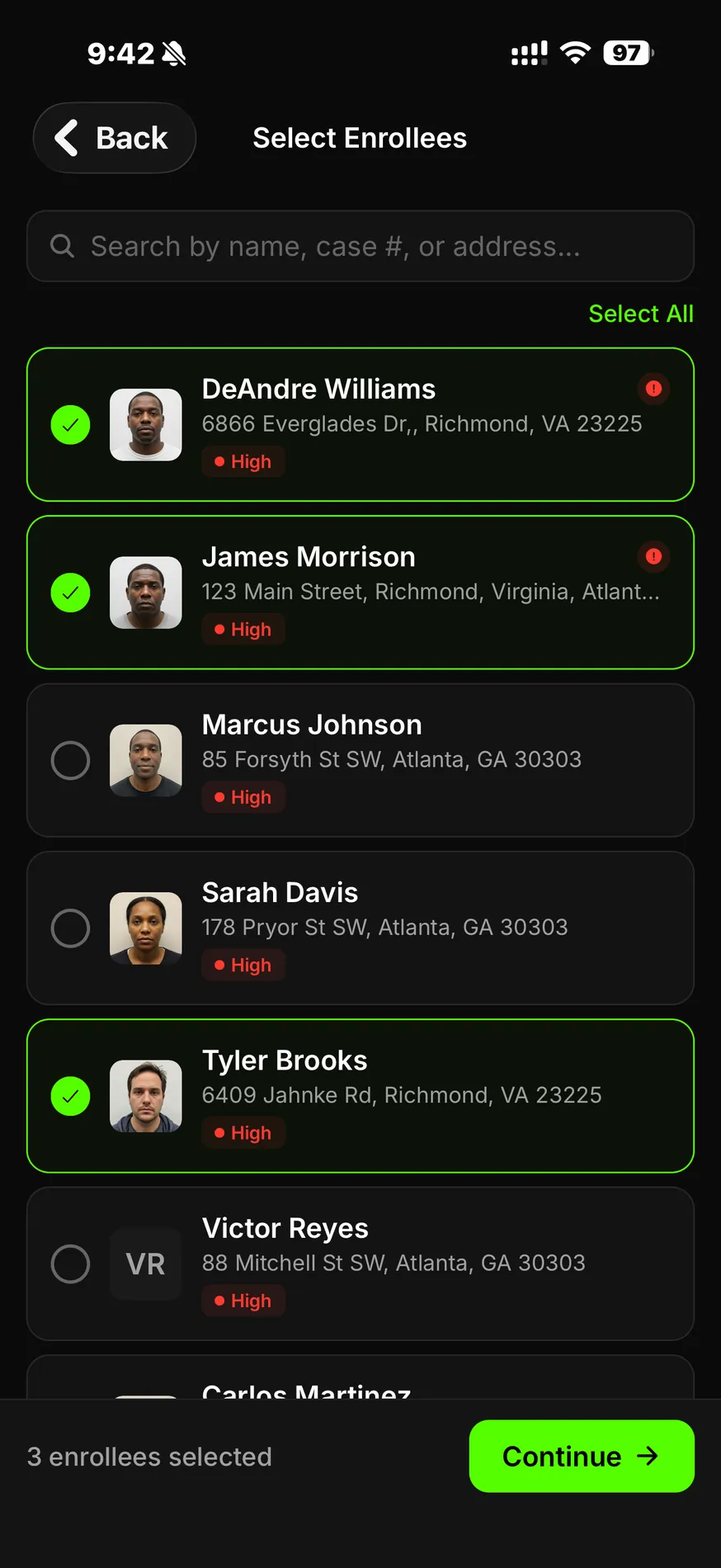
Pick your stops, see each enrollee's risk, and set how long to spend, in seconds.
Address-level alert
215 Riverbend Ct, Covington
Logged by Ofc. Reyes · 3 weeks ago
Hazards follow the address, not just the person
Logged once, shown forever
A hazard one officer logs at a door stays attached to that address.
Same door, any enrollee
Visit a different person there later and the warning is already waiting.
Flagged before you arrive
You see it on approach, not after you knock.
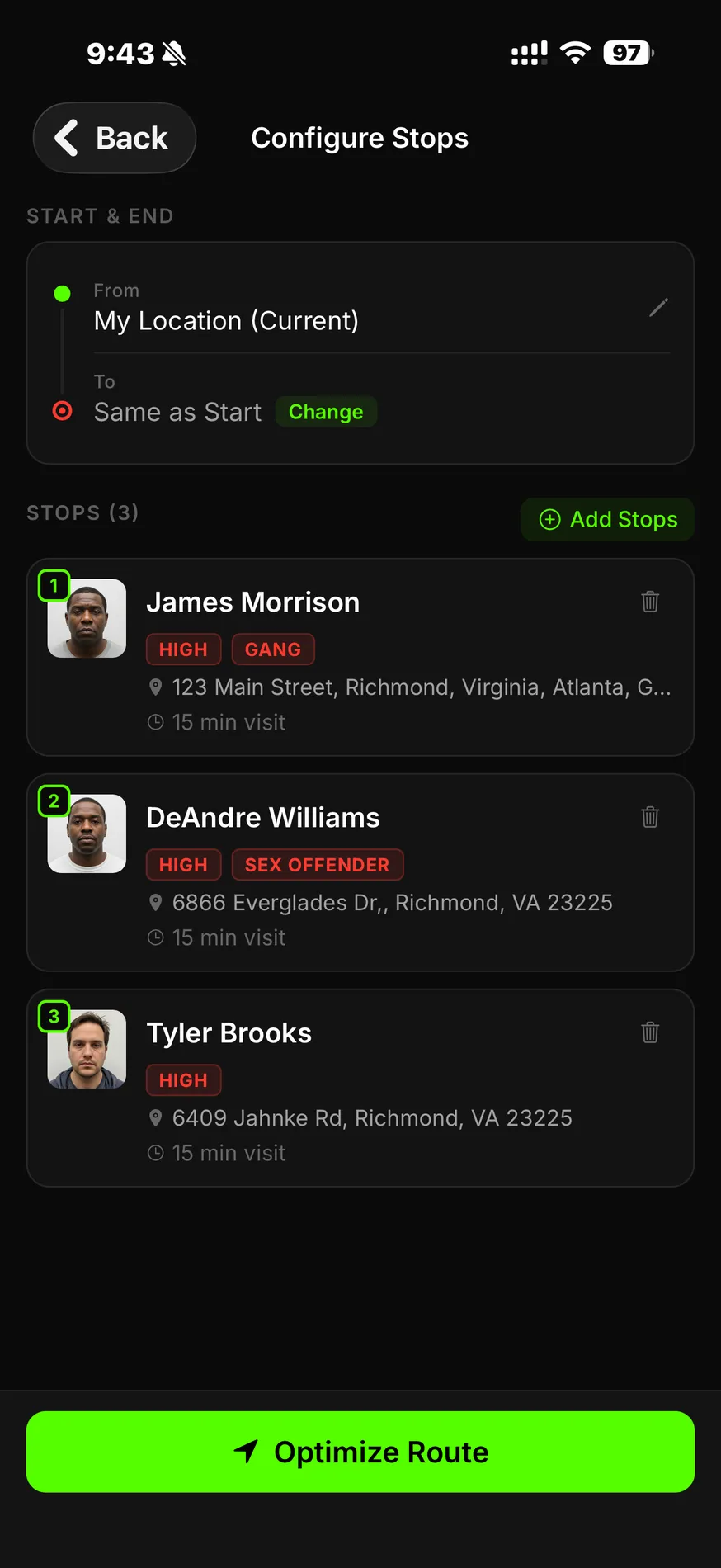
One tap orders the smartest route
Optimize Route sequences every stop from where you are right now, with turn-by-turn directions to each door.
Optimized from your location
Tap once and the day is sequenced around where the officer actually is.
Turn-by-turn to the door
Hand-off to navigation for directions all the way to each stop.
Re-optimizes as the day shifts
Arrive at a stop or skip someone and the route re-orders to match reality.
 1
1Sarah Chen
94 Lakeshore Blvd, Mandeville
2DeAndre Williams
1840 Cypress Bend Dr, Covington
3Maria Gonzalez
12 Heritage Oaks Dr, Madisonville
4Carlos Martinez
77 Bayou Liberty Rd, Slidell
Arrive, confirm, and document
Arrival is detected automatically and a safety timer covers the visit: a reference that escalates if it runs out, never a limit. Tap ShadowSession to capture everything.
James Morrison
215 Riverbend Ct, Covington
Escalates automatically if it runs out
It listens, writes the report, and does the busywork
One tap turns the conversation into a transcript, a drafted session report, and ready-to-run action items, finished before the next stop.
ShadowSession
Tapped during the visit
A safety net that never looks away
If a visit isn't closed out, Shadowtrack escalates on your agency's terms, and a duress PIN triggers silent help at any moment.
Duress PIN
On screen it looks identical to your normal PIN: a routine extend or end. Enter the duress PIN instead and it silently alerts the right people on your agency's protocol, with no warning to anyone nearby.
Confirm PIN
Enter your PIN to extend or end the visit
Forgot to end or extend?Per agency
Step 1
Visit timer reached
The reference timer elapses without an extend or end.
Step 2
Reminder nudge
A notification asks the officer to extend or end the visit.
Step 3
Extend or end with PIN
The officer confirms they're safe with their standard PIN.
Step 4
Tiered escalation
Still unhandled? Contacts are alerted in the agency's configured order.
Step 5
Dispatched help / 911
The ladder ends in real-world response if no one checks in.
The office sees it while you're still out
Every stop closes with an outcome and a PIN. Finished days auto-generate itinerary reports admins watch live on desktop.
Ofc. RiveraOfc. ReyesOfc. DanielsOfc. BrooksOfc. HayesOfc. Cole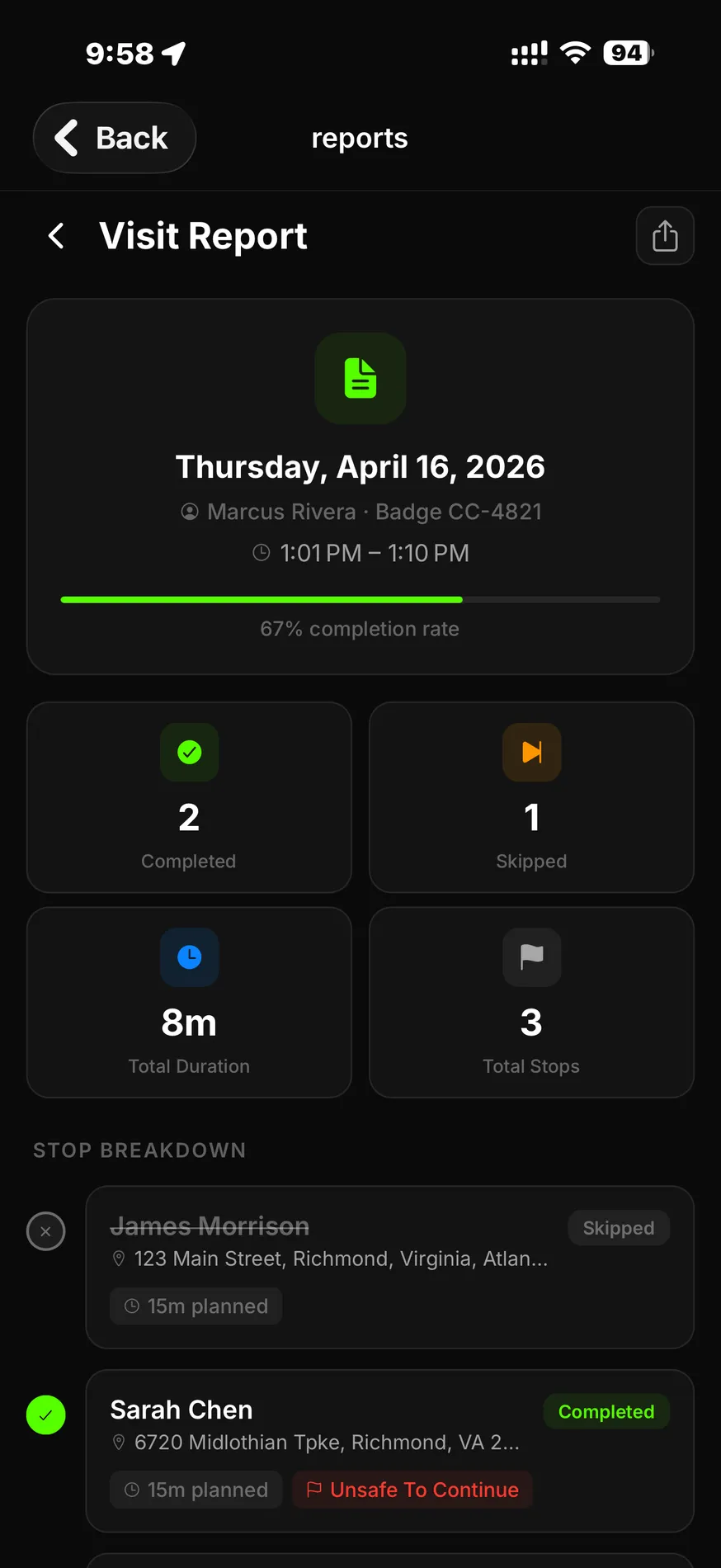
Today's itineraries
See every officer's planned route and live progress at a glance.
Who's in an active visit
Live list of officers currently on a stop, with running timers.
Run field-visit reports
Auto-generated per day, exportable by officer, date, or outcome.
Common questions about officer safety
How does Shadowtrack keep probation officers safe on field visits?
Officers plan their own day, and Shadowtrack provides the tools that make it fast and safe. The platform attaches hazard warnings to each address, navigates door to door, and runs a visit timer the officer sets. If a visit runs long, the officer is reminded first to extend or end it, and only then do escalations go out. A silent duress PIN signals distress without alerting anyone nearby.
What is hazard intelligence?
Hazard intelligence attaches safety warnings, like aggressive dogs or weapons seen on site, to the address itself, not just the person. Once a hazard is logged it is shown to every officer who visits that address afterward, so hard-won knowledge is never lost.
What happens if an officer doesn't check out of a visit?
The officer is reminded first, so a forgotten check-out or an un-extended timer does not immediately trigger a response. If there is still no answer, the system escalates automatically, alerting the team and supervisors with the officer's last known location. Officers never have to remember to call for help.
What is a duress PIN?
A duress PIN is an alternate code an officer can enter under coercion. It appears to work normally but silently signals an emergency with the officer's location and the enrollee or participant they are with, so help can be dispatched without escalating the situation on scene.
Can officers document field visits in Shadowtrack?
Yes. Officers can initiate a ShadowSession audio recording during a field visit, and the contact can be one person or several, such as the enrollee along with a family member or a neighbor; multiple people can be detected. The platform automatically drafts a report with the action items it identified, and the officer can edit the draft, approve it, and execute those action items automatically. Full itineraries and the reports generated from them are associated with the officer's account, with dashboards showing this activity and who is out in the field.
How does day planning work for field officers?
Officers pick their stops and the system automatically generates the route based on the officer's starting and ending locations, showing each enrollee's risk level along the way. Officers can skip a stop and the route recalculates, and navigation guides them to the correct door, not just the street address.